Dental Implant Cutout With a Clear Backdrop
About Dental Implant #286
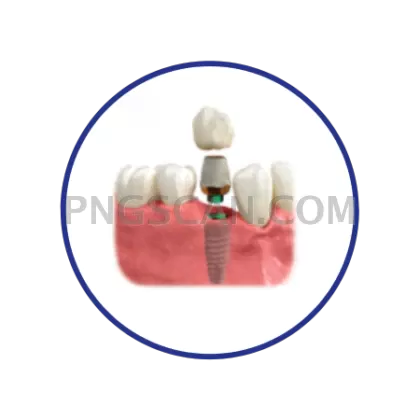
Most implant graphics hide the part patients actually want to see. This dental implant png 450x450 cutout does the opposite: it slices through the jawbone so the threaded titanium post, the abutment collar and the ceramic crown all read at a glance. Because the backdrop is cleared out, nothing competes with the anatomy.
Dental practices drop it into treatment consent forms and waiting-room screens. Hygienists use it in patient education handouts where the difference between a crown and an implant needs explaining fast. It also shows up in dental lab catalogs, oral surgery course decks, prosthodontics study notes, and health-insurance explainer pages covering restorative coverage. You might also like Dental Implant.
At this size it works best as a supporting figure rather than a hero image. Pair it with a short label line for each component and keep it above 200px on screen so the thread detail stays legible. If you need it larger, scale in a vector-aware tool or place it inside a fixed-width container rather than stretching it in HTML. You might also like Dental Implant.
The file ships as a 32-bit PNG with an 8-bit alpha channel, so the cut edges around the gum tissue stay smooth on white, dark, and colored layouts. Natural color grading means no recoloring needed for clinical contexts. Free license, no attribution required, fine for commercial patient-facing material. Explore more Dental Implant PNG images in our gallery.
Frequently Asked Questions
Answers about this Dental Implant #286 PNG — transparent background, size, download, and permitted use.
From bottom to top: the threaded titanium fixture that integrates with the jawbone, the abutment that connects upward through the gum line, and the ceramic crown that forms the visible tooth surface.
It prints acceptably at roughly 1.5 inches wide at 300 DPI. For a full-page anatomical figure or poster, source a higher-resolution version instead.
It is an illustrative cutaway, good for explaining implant structure to patients or introductory students. For surgical planning or specialist coursework, use radiographic or manufacturer reference imagery.
More from the Dental Implant Collection

Related Transparent PNG Images

SUP Board

SUP Board 1500x1500

SUP Board natural

SUP Board 600x600

SUP Board 1000x1000